


Open Banking Casino: How Pay-by-Bank Works and How to Spot Fake “Instant Banking”
Open Banking Casinos
An open banking casino lets you pay straight from your bank account through a regulated provider: you’re sent to your own bank, you approve the payment there, and the money reaches the casino in seconds. No card, no e-wallet, and no bank login ever shared with the casino. The catch is that many sites use “open banking,” “instant banking” and “pay by bank” interchangeably, and the safest versions and the riskiest ones can look almost identical on a cashier page.
This guide explains how open banking actually works at casinos, what the casino can and can’t see, which providers run it, and the checks that tell regulated open banking apart from an offshore “instant banking” button.
Open Banking Casino List October, 2026
Advertiser Disclosure
This website is created and driven by online gambling experts with multiple years in the igaming industry. Topnoaccountcasinos will always remain free of charge and its primarly task is to provide transparent and accurate information to its users. We operate and make money via affiliate commission, so the compensation does not influence our recommendation, review or analysis of any given online casino on the website.

TrivelaBet
200% up to €1,000 + 10% daily cashback
- Kahnawake licence verified
- 10% daily cashback, no wagering
Payment Methods












Rise Of Bets
Up to $/€1000 + 1000 Free Spins
- EU licenced casino
- Casino, live casino and sports betting!
Payment Methods

SpinFever
100% up to $500 + 50 Free Spins
- Super fast deposit and withdrawals
- Exclusive welcome bonus new players
Payment Methods

Casino Infinity
Up to €3,000 + 350 FS over 4 deposits
- Large game library
- Casino + live casino
Payment Methods




Casombie
Up to €3,000 + 300 FS over 4 deposits
- Zombie-themed casino
- Large game library
Payment Methods


Slots Hammer
120% up to $/€300
- Fast deposit and withdrawals with Interac
- Exclusive Casino & Sports Bonus
Payment Methods

Wonaco Casino
100% up to €500 + 200FS
- Crypto accepted
- Smooth registration
Payment Methods

Starzino Casino
Up to €1,500 + 150 free spins (40x bonus)
- Quick sign-up with Apple, Google or Telegram
- €5,000/day, €20,000/30 days withdrawals
Payment Methods

Scarabet
150% up to $/€ 200
- Massive Selection of Games
- Instant deposits & withdrawals
Payment Methods

Nords Casino
225% up to €1,500 + 500 FS (35x deposit + bonus)
- MGA licence MGA/B2C/233/2013
- Free ADR via MADRE
Payment Methods



What is an open banking casino?
An open banking casino is an online casino that accepts payments made through a licensed payment initiation provider. The provider connects to your bank through a secure interface that banks have been legally required to offer since 2018, you confirm the payment in your bank’s own app or website, and the casino receives an instant confirmation.
In Europe, this framework comes from PSD2, the EU’s second Payment Services Directive. In the UK it was implemented on 13 January 2018 alongside an order from the Competition and Markets Authority, which made open banking a regulatory requirement for the largest banks.
Pay-by-bank methods you’ve probably seen at casinos, such as Trustly, Zimpler, TrueLayer, Brite and Volt, all run on this principle.
How an open banking payment works
- You choose a pay-by-bank method in the casino cashier and enter an amount.
- You pick your bank. The provider shows a list of connected banks in your country.
- You’re redirected to your own bank, usually its app, and log in with its normal security: BankID, face or fingerprint, or a code.
- You approve the exact payment inside your bank.
- The provider confirms it to the casino, and the deposit is credited immediately.
Withdrawals run in reverse: the casino approves your request, and the provider pays the money back to the same account, often within minutes.
Understand Instant Banking
- Instant banking is a term that refers to the practice of sharing banking data with third-party providers.
- This data includes transaction history, account balances, and other financial information. It can also include information such as your name.
- Data is accessed through an API that helps different software communicate.
- This is beneficial at online gambling sites where it can be used to process deposits and withdrawals quick but also help the player to identify themselves and
What the casino can and can’t see
This is where many guides get it wrong.
For a payment, the provider initiates a single transfer you’ve approved. The casino learns that the payment succeeded, the amount, and the account it came from. It does not get your bank login, your balance or your transaction history.
For verification, some casinos, notably Pay N Play casinos, also receive verified identity details from your bank, such as your name, date of birth and address. That’s how they can open and verify your account in one step. You’re still verified; your bank simply supplies the data.
Account data access (balances and transaction history) is a separate service under PSD2, called account information. It needs its own explicit consent, and it’s clearly shown on the bank’s consent screen. If a casino-related service ever asks for ongoing access to your account history, read the screen carefully and only agree if you understand why, for example a formal affordability check in a regulated market.
1: Amok Casino
Advertiser Disclosure
This website is created and driven by online gambling experts with multiple years in the igaming industry. Topnoaccountcasinos will always remain free of charge and its primarly task is to provide transparent and accurate information to its users. We operate and make money via affiliate commission, so the compensation does not influence our recommendation, review or analysis of any given online casino on the website.
Collect a 10% wager-free cashback bonus every week. Instant registration and withdrawals withing one hour. Amok uses their own instant banking solution that is tailor made for the group of Frenwall limited, and is extremely fast and reliable. Enjoy over 6000 casino games and cashback bonuses.
2: Happy Spins Casino
Another casino that utilizes the same method to ease the registration process for new customers is Happy Spins Casino. You can collect a welcome bonus on your first deposit with almost no effort. Claim the bonus, and you will be rewarded with 200% up to $200 + 10% daily Cashback bonus!
3: Playzilla Casino
If you want more money to play with, Playzilla casino is the right casino. By making a bank transfer (of at least the minimum deposit), you can claim a welcome bonus of 100% up to $1500 + 500 Free spins. This is a casino with huge potential, with players’ experience as a top priority.
Open banking vs “instant banking” vs Pay N Play
These terms overlap, and casinos use them loosely. Here’s how they actually differ:
| Regulated open banking | “Instant banking” button | Pay N Play | Standard bank transfer | |
|---|---|---|---|---|
| Who handles the payment | A named, licensed payment initiation provider | Often unclear: may be regulated, may be a proprietary or offshore processor | Trustly (or Zimpler Go, Brite) | Your bank, via IBAN |
| Where you log in | Your own bank’s app or website | Sometimes a third-party page asking for your bank credentials | Your own bank | Your own bank |
| Speed | Instant deposit | Varies | Instant deposit | Often instant in euros now, otherwise 1-3 days |
| Creates your casino account | Not by itself | No | Yes, in one step | No |
| Identity verification | Payment only, unless combined with an ID service | Varies | Built in | No |
| Typical casinos | Licensed casinos in the UK, Nordics and EU | Often offshore | Nordic and other licensed markets | Everywhere |
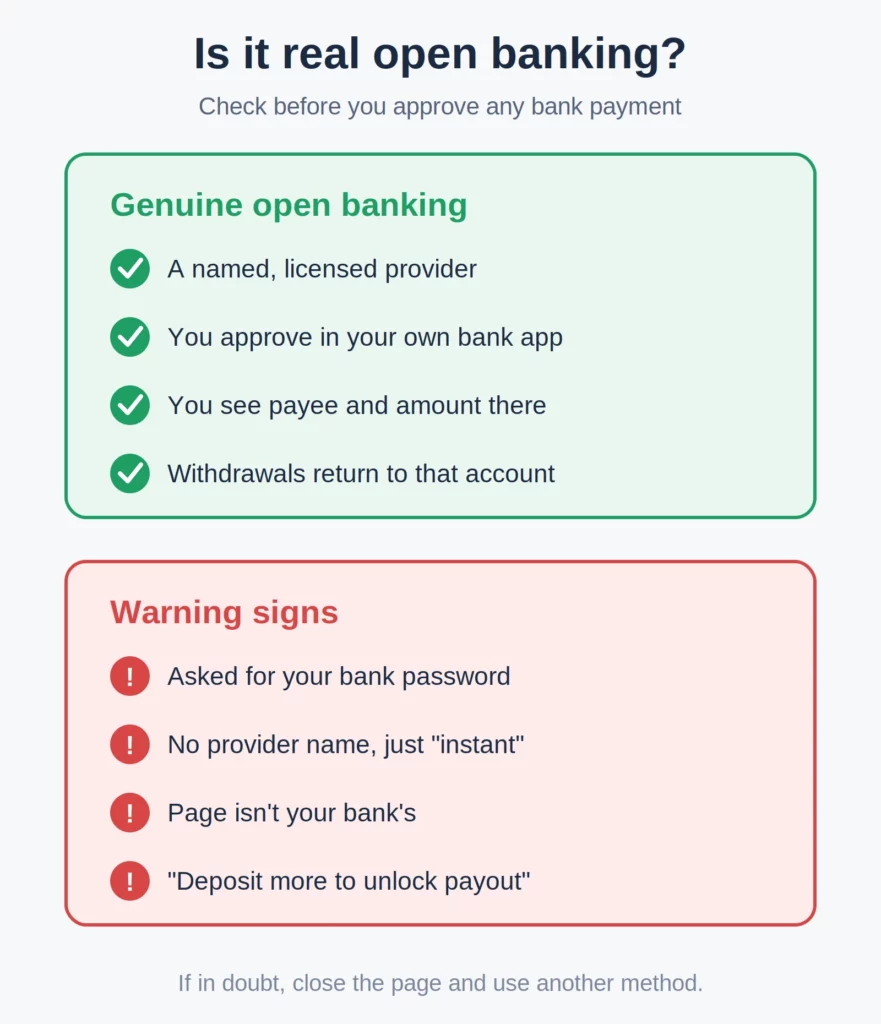
The key distinction: genuine open banking always sends you to your own bank to approve. If a payment page asks you to type your online banking username and password into a form that isn’t your bank, you’re not using regulated open banking. Close the page.
Why offshore “instant banking” deserves a closer look
Some offshore casino groups advertise their own “instant banking” or “instant bank transfer” solution. That isn’t automatically unsafe, but you can’t judge it by the label. Check which company actually processes the payment, whether it’s authorised by a financial regulator, and whether you’re redirected to your own bank. Our guide to Frenwall Limited casinos is one example of a group running its own payment flow, and our pages on Curaçao-licensed casinos explain why payment protections differ outside regulated European markets.
It’s also worth separating open banking from instant play casinos. “Instant play” means playing in your browser without downloading software. It has nothing to do with how you pay.
Open banking providers you’ll see at casinos
| Provider | Based in | Regulated by | Strongest markets | Worth knowing |
|---|---|---|---|---|
| Trustly | Sweden | Finansinspektionen; FCA in the UK | Nordics, wider Europe, UK | Invented Pay N Play in 2015; 12,000 connected banks |
| Zimpler | Sweden | Finansinspektionen | Sweden, Finland | Owned by TrueLayer since March 2026; offers Swish payouts |
| TrueLayer | UK | FCA | UK, wider Europe (22 countries) | Serves 100+ iGaming brands; now owns Zimpler |
| Brite | Sweden | Finansinspektionen | Nordics, EU | Founded 2019; fast payouts |
| Volt | UK | FCA | UK, Europe | Payment initiation and e-money authorisation |
For the Dutch market, iDEAL works on a similar bank-authorised principle. Klarna’s pay-now bank payments (formerly Sofort) are common in German-speaking countries, though usually for deposits only. If you bet on sports, see our guides to Trustly betting sites, Zimpler betting sites and no-account betting.
How big is open banking now?
It has moved well beyond a niche. In the UK, where it’s most mature, Open Banking Limited reported in July 2026 that the ecosystem had passed one billion payments since launch, with more than 40 million open banking payments in June 2026 alone.
In the EU, the framework is about to be upgraded. Lawmakers reached a provisional agreement on PSD3 and a new Payment Services Regulation in November 2025. The package strengthens open banking interface standards, fraud protections and Verification of Payee, and is expected to apply from around late 2027. Separately, euro-area banks have had to send instant credit transfers since October 2025, which is making bank payments faster across the board. Our fast payout casinos guide explains what that means for withdrawals.
Is open banking safe for casino payments?
Yes, when it’s genuine. Payments are authorised inside your own bank with strong customer authentication, the provider is licensed and supervised, and the casino never receives your login or card details.
It isn’t fraud-proof, though. The main risk isn’t the technology but being tricked into approving a payment to someone else, known as an authorised push payment scam. That’s why the EU introduced a free Verification of Payee check in October 2025, which warns you if the account name doesn’t match the IBAN. For casino players, the practical rules are simple:
- Only approve payments inside your own bank app, never on a page that asks for your bank password.
- Check the payee name and amount on your bank’s approval screen.
- Look up the provider if you don’t recognise it. Authorised payment institutions are listed on public registers such as the UK’s FCA register.
- Be wary of “unlock your withdrawal” deposit requests. A legitimate casino never asks you to deposit more to release a payout.
Before depositing somewhere new, check the licence and our casino blacklist.
Deposits, withdrawals and verification
Open banking deposits are instant, and minimums are set by the casino, usually around €10. See our guide to minimum deposit casinos for lower-entry options.
Withdrawals are usually paid within minutes once the casino has approved them, back to the account you deposited from. Because the account is already confirmed as yours, open banking withdrawals rarely stall on paperwork. Most delays come from the casino’s approval process or an active bonus; our guide to wagering requirements explains how bonuses lock withdrawals.
Open banking also speeds up identity checks, because the data comes from a bank that already verified you. It doesn’t remove verification, which regulated casinos must carry out by law. Our guide on why casinos verify your account covers the rules. Casinos that skip checks at sign-up, such as many no-verification casinos, work on a different model where checks typically happen later, at withdrawal.
Open banking vs other payment methods
| Method | Deposit | Withdrawal | Separate account | Shares card or bank login with casino |
|---|---|---|---|---|
| Open banking (Trustly, Zimpler, TrueLayer, Brite, Volt) | Instant | Minutes after approval | No | No |
| Skrill and other e-wallets | Instant | Often within 24 hours | Yes | No |
| PayPal | Instant | Often within 24 hours | Yes | No |
| Visa debit | Instant | 1-3 business days | No | Card number, stored by the casino’s processor |
| Pay by phone | Instant | Not supported | No | No |
| Standard bank transfer | Often instant in euros | 1-3 days | No | No |
For the full picture, see our overview of casino payment methods.
Summary
While instant banking has made playing at online casinos safer and more accessible, it also has the potential to help players block themselves from gambling. If you are looking for a safe and easy way to gamble online, look for casinos that offer instant banking.
With this type of technology, you can share validated information from your bank with the casino of your choice without having to register or verify yourself. Making it easy to make transactions using Payment Initiation services.
Pros
- Instant deposits and fast withdrawals, typically minutes after casino approval.
- No card or wallet details shared with the casino.
- Your bank's own security protects every payment.
- No extra account to create or top up.
- Quicker verification, and at Pay N Play casinos, no registration form at all.
- Only real funds. You pay from money in your account, not from credit.
Cons
- Not every bank or country is covered.
- Gambling transactions appear on your bank statement.
- Deposits are so easy that limits matter more.
- "Instant banking" labels can hide unregulated processors, especially at offshore casinos.
- Some methods are deposit-only, so check that withdrawals are supported.
Who open banking suits
A strong choice if you:
- bank in the UK, the Nordics or another country with good open banking coverage;
- want fast payouts without an e-wallet in the middle;
- prefer not to share card details with casinos;
- play mainly on your phone, where your banking app makes approval quick (see our mobile casino guide).
Consider something else if you:
- want casino spending kept separate from your main account;
- want a hard spending cap built into the payment method, as prepaid vouchers offer;
- bank with a provider that isn’t connected.
Responsible play with bank payments
Paying straight from your bank means you can only use money you actually have, which is a real advantage over credit. The flip side is speed. Set a deposit limit at every casino, turn on your bank’s spending notifications, and decide your budget before you open the cashier. Some banks offer gambling blocks; check whether yours covers bank-transfer payments as well as card payments. National self-exclusion schemes such as Spelpaus, CRUKS and GAMSTOP block deposits at licensed casinos in their markets. Our guide on how to ban yourself from gambling explains the options, and our stop gambling page lists where to get help.
Summary
Open banking lets you pay a casino directly from your bank through a licensed provider, with approval inside your own banking app, instant deposits and fast withdrawals. It’s one of the safest and quickest ways to play, and it’s the technology behind Pay N Play and casinos without an account.
The one thing to watch is the label. Genuine open banking names its provider and sends you to your own bank; a vague “instant banking” button that asks for your bank password does not. Check the provider, check the licence, set your limits, and open banking will do exactly what it promises.
FAQ: Open banking casinos
It’s an online casino that accepts payments through a licensed open banking provider. You approve each payment in your own bank’s app or website, and the casino receives the money instantly without seeing your bank login or card details.
Not always. Regulated open banking uses licensed providers and redirects you to your own bank. “Instant banking” is a marketing label that sometimes means regulated open banking and sometimes means a proprietary or offshore processor. Check which company actually handles the payment.
No. A payment initiation tells the casino that your payment succeeded, the amount and the account it came from. Your balance and transaction history are only shared if you separately and explicitly consent to account information access.
Yes, when it’s genuine. Payments are authorised with your bank’s own security and handled by regulated providers. Never enter your bank login on a page that isn’t your bank’s, and check the payee on your bank’s approval screen.
At most casinos using providers such as Trustly, Zimpler or Brite, yes. Winnings are paid back to the account you deposited from, usually within minutes of approval. Some bank payment methods are deposit-only, so check the cashier.
Yes. Open banking can make verification faster, because your bank supplies confirmed details, but licensed casinos must still verify every player. At Pay N Play casinos this happens automatically during your first deposit.
Common ones include Trustly, Zimpler, TrueLayer, Brite and Volt. For Dutch players, iDEAL works on a similar bank-authorised principle.
Not for players at reputable casinos. The casino pays the provider. Your bank may charge for currency conversion if your account and the casino use different currencies.
PSD2 is the EU’s second Payment Services Directive. Applied since 2018, it requires banks to give licensed third parties secure access for payments and account information, which is what makes open banking possible. It’s due to be replaced by PSD3 and the Payment Services Regulation.
It’s most developed in the UK and the Nordics and widely available across the EU. Coverage depends on your bank; if it isn’t listed when you choose a pay-by-bank method, it isn’t connected to that provider.
Open banking is the underlying technology for bank payments. Pay N Play is a specific casino product built on it that also verifies your identity and creates your casino account during the first deposit.
Common reasons are a bank that isn’t supported, a bank-side gambling block, insufficient funds, or an approval that timed out in your banking app. Try again, check your bank’s notifications, or choose another method.